Skip to content

Gravitation Numericals

  1. Newton’s law of Gravitation.

F=Gm1m2d2F = \frac{Gm_1m_2}{d^2} , where G is universal gravitational constant.

The value of G is 6.67×10¹¹ Nm2kg26.67 \times 10^{-11} \text{ Nm}^2 \text{kg}^{-2}

  1. The expression for acceleration due to gravity on the surface of earth or large mass.

g=GMR2g = \frac{GM}{R^2}

  1. Variation of ‘g’ with height/altitude (h).

g=g(12hR),g' = g \left(1 - \frac{2h}{R}\right),

  1. Variation of ‘g’ with depth ‘d’.

g=g(1dR)g' = g\left(1 - \frac{d}{R}\right)

  1. Variation of ‘g’ with rotation of earth. / Variation of ‘g’ with latitude.

g=gω2Rcos2θg' = g - \omega^2 R \cos^2 \theta ,

  1. Gravitation Field Intensity (I).

Then, I=GMR2I = \frac{GM}{R^2}

  1. Gravitational Potential (V or vg)

Vg=GMR+hV_g = \frac{-GM}{R + h}

  1. Gravitational Potential Energy (U)

U=GMmrU = -\frac{GMm}{r}

  1. Escape Velocity (Ve),

Ve=2GMRV_e = \sqrt{\frac{2GM}{R}}

Ve=2gRV_e = \sqrt{2gR}

Ve=11.2 kms1V_e = 11.2 \text{ kms}^{-1} , which is the escape velocity of the earth.

  1. Gravitational force provides necessary centripetal force i.e.

mVo2r=GMmr2\frac{mV_o^2}{r} = \frac{GMm}{r^2}

  1. Orbital Velocity

V0=RgR+hV_0 = R \sqrt{\frac{g}{R+h}}

Also,  Vo=GMr  [r=R+h]Also, ~~V_o = \sqrt{\frac{GM}{r}} ~~[r = R + h]

  1. Time period of satellite,

T=2πR(R+h)3gT = \frac{2\pi}{R} \sqrt{\frac{(R+h)^3}{g}}

  1. Height (h) of the satellite,

h=(T2R2g4p2)1/3Rh = \left(\frac{T^2 R^2 g}{4p^2}\right)^{1/3} - R

  1. Total Energy associated with a satellite.

Etotal=K.E.+G.P.E.E_{total} = K.E. + G.P.E.

  1. K.E. = 12\frac{1}{2} m V02=GMm2rV_0^2 = \frac{GMm}{2r}

  2. Gravitational Potential Energy (U)

U=GMmrU = -\frac{GMm}{r}

  1. Total Energy associated with a satellite.

Etotal=GMm2r=GMm2(R+h)E_{total} = -\frac{GMm}{2r} = -\frac{GMm}{2(R+h)}

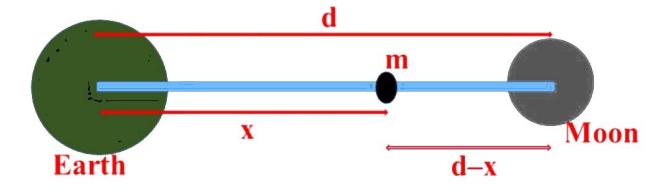
Q. 67 Calculate the point along a line joining the centers of earth and moon where there is no gravitational force.

Let X be the distance of the point from the earth along a line joining the centers of earth and moon where there is no gravitational force

Mass of earth, Me=6×1024 kgM_e = 6 \times 10^{24} \text{ kg}

Mass of moon, Mm=7.4×10²² kgM_m = 7.4 \times 10^{22} \text{ kg}

Distance between their, d=3.8×10⁸ md = 3.8 \times 10^8 \text{ m}

For no gravitational force, if we place an object of mass ‘m’ then

Gravitational force between the earth and the object = Gravitational force between the moon and the object. i.e.

GMemx2=GMmm(dx)2\frac{GM_e m}{x^2} = \frac{GM_m m}{(d-x)^2}

Or, MeMm=(xdx)2\frac{M_e}{M_m} = \left(\frac{x}{d-x}\right)^2

Or, xdx=6×10247.4×1022=9.0045\frac{x}{d-x} = \sqrt{\frac{6 \times 10^{24}}{7.4 \times 10^{22}}} = 9.0045

Or, x=9.0045d9.0045xx = 9.0045d - 9.0045x

Or, x=9.0045×3.8×1081+9.0045x = \frac{9.0045 \times 3.8 \times 10^8}{1 + 9.0045}

Or, x=3.42×10⁸x = 3.42 \times 10^8 m from the earth.

Q.63 Mass of earth is 81 times heavier than the moon. Its diameter is about 4 times larger than that of the moon. Estimate the value of acceleration due to gravity on the surface of moon.

Let M and m be the masses, D and d be the diameter and R and r be the radius of earth and moon respectively.

M=81mM = 81m

D=4dD = 4d

2R=4×2r2R = 4 \times 2r

R=4rR = 4r

Acceleration due to gravity on the surface of moon, gm=?g_m = ?

On the surface of earth, acceleration due to gravity

ge=GMR2g_e = \frac{GM}{R^2} …(i)

On the surface of moon, acceleration due to gravity

gm=Gmr2(ii)g_m = \frac{Gm}{r^2} \dots (ii)

Dividing equation (ii) by (i),

gegm=mr2×R2M\frac{g_e}{g_m} = \frac{m}{r^2} \times \frac{R^2}{M}

Or,gm=gemr2×(4r)2M{\rm Or}, \qquad g_m = g_e \, \frac{m}{r^2} \times \frac{(4r)^2}{M}

Or, gm=gcmr2×(4r)2Mg_m = g_c \frac{m}{r^2} \times \frac{(4r)^2}{M}

Or, gm=gemr2×(4r)281mg_m = g_e \frac{m}{r^2} \times \frac{(4r)^2}{81m}

Or, gm=9.8×1681=1.94 ms2g_m = 9.8 \times \frac{16}{81} = 1.94 \text{ ms}^{-2}

  1. A man can jump 1.5m on earth. Calculate the approximate height he might be able to jump on a planet whose density is one quarter of the earth and where radius is one third that of the earth.

Here,

Height on earth, hE=1.5mh_E = 1.5 \text{m}

Height on the planet, hp=?h_p = ?

If ρP\rho_P and ρE\rho_E be the density and RPR_P and RER_E be the radius of planet and earth respectively then according to question,

ρP=ρE4& RP=RE3\rho_P = \frac{\rho_E}{4} \qquad \& \ R_P = \frac{R_E}{3}

For a given man, Initial K.E. of man at planet = Initial K.E. of man at earth.

and according to Work energy theorem, we can write

Potential Energy at planet = Potential energy at earth

Or, mgphp=mgEhEmg_ph_p = mg_Eh_E

Or, hP=hEgEgp(i)h_P = h_E \frac{g_E}{g_p} \dots (i)

Since g=GMR2g = \frac{GM}{R^2}

Or, hP=hEGMERE2GMPRP2h_P = h_E \, \frac{\frac{G M_E}{R_E{}^2}}{\frac{G M_P}{R_P{}^2}}

Or, hP=hE×VEρERE2×RP2VPρPh_P = h_E \times \frac{V_E \rho_E}{R_E^2} \times \frac{R_P^2}{V_P \rho_P}

Or, hP=hE× ⁣4/3πRE3  ρERE2×RP24/3πRP3  ρPh_P = h_E \times \! \frac{4/3\pi R_E{}^3 \; \rho_E}{{R_E}^2} \times \frac{R_P{}^2}{4/3\pi R_P{}^3 \; \rho_P}

Or, hP=hE×REρE×3×4REρEh_P = h_E \times R_E \rho_E \times \frac{3 \times 4}{R_E \rho_E}

Or, hP=1.5×3×4=18mh_P = 1.5 \times 3 \times 4 = 18 \text{m}

:. The man can jump upto a height of 18m.

Q.2 Find the height of the geostationary satellite above the earth assuming earth as a sphere of radius 6370 km.

Solution,

Here,

The time period for geostationary satellite,

T=24 hrs=24×60×60T = 24 \text{ hrs} = 24 \times 60 \times 60

= 86400 sec

Radius of earth, R=6370km=6.37×10⁶mR = 6370 \text{km} = 6.37 \times 10^6 \text{m}

Height of satellite, h = ?

We know, time period,

T=2πR(R+h)3gT = \frac{2\pi}{R} \sqrt{\frac{(R+h)^3}{g}}

T=2πR(R+h)3/2g1/2T = \frac{2\pi}{R} \frac{(R+h)^{3/2}}{g^{1/2}}

Or, (R+h)3/2=TRg1/22π(R+h)^{3/2} = \frac{TRg^{1/2}}{2\pi}

Or, R+h=(TRg1/22π)2/3R + h = \left(\frac{TRg^{1/2}}{2\pi}\right)^{2/3}

Or, h=(TRg1/22π)2/3Rh = \left(\frac{TRg^{1/2}}{2\pi}\right)^{2/3} - R

Or, h=(86400×6.37×106×101/22π)2/36.37×106h = \left(\frac{86400 \times 6.37 \times 10^6 \times 10^{1/2}}{2\pi}\right)^{2/3} - 6.37 \times 10^6

= 36122818.44 m = 36122.82 Km

Q.58 A remote sensing satellite of the earth revolves in a circular orbit at a height of 250 km above the earth’s surface. What is the orbital speed and a period of revolution of the satellite?

Here,

Height, h=250 km=250×103 kmh = 250 \text{ km} = 250 \times 10^3 \text{ km}

Radius of earth, R=6400 km=6.4×10⁶ mR = 6400 \text{ km} = 6.4 \times 10^6 \text{ m}

  • (i) Orbital speed, V0=?V_0 = ?
  • (ii) Time period, T = ?

We have

(i) Orbital speed, V0=RgR+hV_0 = R \sqrt{\frac{g}{R+h}} Or, V0=6.4×106106.4×106+250×103V_0 = 6.4 \times 10^6 \sqrt{\frac{10}{6.4 \times 10^6 + 250 \times 10^3}}

Or, V0=6.4×106106.4×106+250×103V_0 = 6.4 \times 10^6 \sqrt{\frac{10}{6.4 \times 10^6 + 250 \times 10^3}}

Or, V0=7848.18 ms1V_0 = 7848.18 \text{ ms}^{-1}

(ii) Time period

We have, time period,

T=2πR(R+h)3gT = \frac{2\pi}{R} \sqrt{\frac{(R+h)^3}{g}} Or, T=2π6.4×10⁶(6.4×10⁶+250×103)310T = \frac{2\pi}{6.4 \times 10^6} \sqrt{\frac{(6.4 \times 10^6 + 250 \times 10^3)^3}{10}}

T=5324 sec=532460=88.73 min\therefore T = 5324 \text{ sec} = \frac{5324}{60} = 88.73 \text{ min}

Here,

Time period, T=2.5 hrs=2.5×60×60=9000 secT = 2.5 \text{ hrs} = 2.5 \times 60 \times 60 = 9000 \text{ sec}

Radius of earth, R=6370km=6.37×10⁶mR = 6370 \text{km} = 6.37 \times 10^6 \text{m}

Height of the satellite, h = ?

We know, time period

T=2πR(R+h)3gT = \frac{2\pi}{R} \sqrt{\frac{(R+h)^3}{g}}

T=2πR(R+h)3/2g1/2T = \frac{2\pi}{R} \frac{(R+h)^{3/2}}{g^{1/2}}

Or, (R+h)3/2=TRg1/22π(R+h)^{3/2} = \frac{TRg^{1/2}}{2\pi}

Or, R+h=(TRg1/22π)2/3R + h = \left(\frac{TRg^{1/2}}{2\pi}\right)^{2/3}

Or, h=(TRg1/22π)2/3Rh = \left(\frac{TRg^{1/2}}{2\pi}\right)^{2/3} - R

Or, h=(9000×6.37×106×101/22π)2/36.37×106h = \left(\frac{9000 \times 6.37 \times 10^6 \times 10^{1/2}}{2\pi}\right)^{2/3} - 6.37 \times 10^6

h=3037.36 Kmh = 3037.36 \text{ Km}

We know,

h=(T2R2g4π2)1/3R=3037.36 Kmh = \left(\frac{T^2 R^2 g}{4\pi^2}\right)^{1/3} - R = 3037.36 \text{ Km}

The height of the satellite above the earth is 3037.36 km.

Q. 61. Obtain the value of g from the motion of moon assuming that its period of rotation round the earth is 27 days 8 hours and the radius of the orbit is 60.1 times the radius of the earth.

Here

Acceleration due to gravity on earth, g = ?

Time period, T = 27 days 8 hours

=(27×24+8)×60×60= (27 \times 24 + 8) \times 60 \times 60

We know, radius of earth R=6.4×10⁶mR = 6.4 \times 10^6 \,\text{m}

If the radius of orbit of satellite be ‘r’ then we can write,

r=60.1R=60.1×6.4×106mr = 60.1 R = 60.1 \times 6.4 \times 10^6 m

= 2361600 Sec

We have the time period of satellite,

T=2πR(R+h)3gT = \frac{2\pi}{R} \sqrt{\frac{(R+h)^3}{g}}

Or, g=(2πRT)2r3g = \left(\frac{2\pi}{RT}\right)^2 r^3 [since r=R+hr = R + h ]

Or, g=(2π6.4×106×2361600)2(60.1×6.4×106)3g = \left(\frac{2\pi}{6.4 \times 10^6 \times 2361600}\right)^2 (60.1 \times 6.4 \times 10^6)^3

Or, g=9.83 ms2g = 9.83 \text{ ms}^{-2}

Q. 62. The period of moon revolving under the gravitational force of the earth is 27.3 days. Find the distance of moon from the centre of the earth if the mass of earth is 5.97×10245.97 \times 10^{24} kg.

Here,

Time period, T=27.3 days=27.3×24×60×60T = 27.3 \text{ days} = 27.3 \times 24 \times 60 \times 60

= 2358720 sec

The distance of moon from the centre of the earth, r = ?

Mass of the earth, M=5.97×1024 kgM = 5.97 \times 10^{24} \text{ kg}

We have the time period of satellite,

T=2πR(R+h)3gT = \frac{2\pi}{R} \sqrt{\frac{(R+h)^3}{g}} here, R+h=rR + h = r

Or, T=2πRr3gT = \frac{2\pi}{R} \sqrt{\frac{r^3}{g}}

Or, T=2πr3gR2T = 2\pi \sqrt{\frac{r^3}{gR^2}}

Or, T=2πr3GMT = 2\pi \sqrt{\frac{r^3}{GM}} [Since g=GMR2g = \frac{GM}{R^2} ]

Or, r=(T24π2×GM)1/3r = \left(\frac{T^2}{4\pi^2} \times GM\right)^{1/3}

Or, r=(235872024π2×6.67×1011×5.97×1024)1/3r = \left(\frac{2358720^2}{4\pi^2} \times 6.67 \times 10^{-11} \times 5.97 \times 10^{24}\right)^{1/3}

r=3.828×10⁸ mr = 3.828 \times 10^8 \text{ m}

Q. 66. An earth satellite moves in a circular orbit with a speed of 6.2 kms-1. Find the time of one revolution and its centripetal acceleration.

Section titled “Q. 66. An earth satellite moves in a circular orbit with a speed of 6.2 kms-1. Find the time of one revolution and its centripetal acceleration.”

Here.

Orbital velocity, V0=6.2 kms1=6.2×10³ms1V_0 = 6.2 \text{ kms}^{-1} = 6.2 \times 10^3 \text{ms}^{-1}

  • (i) Time Period, T = ?
  • (ii) Centripetal acceleration, ac=?a_c = ?

We have, time period,

T=2πR(R+h)3g(i)T = \frac{2\pi}{R} \sqrt{\frac{(R+h)^3}{g}} \dots (i)

Also,

(i) Orbital speed, V0=RgR+hV_0 = R \sqrt{\frac{g}{R+h}} [N.B. Also, Vo=GMrV_o = \sqrt{\frac{GM}{r}} ]

[N.B. Also, V0=GMrV_0 = \sqrt{\frac{GM}{r}} ]

Or, R+h=(RVo)2×gR + h = \left(\frac{R}{V_o}\right)^2 \times g

Or, R+h=(6.4×1066.2×103)2×10R + h = \left(\frac{6.4 \times 10^6}{6.2 \times 10^3}\right)^2 \times 10

Or, R+h=10655567.12 mR + h = 10655567.12 \text{ m}

From equation (i)

T=2π6.4×10⁶(10655567.12)310T = \frac{2\pi}{6.4 \times 10^6} \sqrt{\frac{(10655567.12)^3}{10}}

T=10798.5 sec=10798.560×60T = 10798.5 \text{ sec} = \frac{10798.5}{60 \times 60}

=2.9996 hrs=3 hrs.= 2.9996 \text{ hrs} = 3 \text{ hrs}.

(ii) Centripetal acceleration,

ac=V2ra_c = \frac{V^2}{r} [ as Fc=mV2rF_c = \frac{mV^2}{r} ]

Or, ac=(6.2×10³)21065556712=3.61 ms2a_c = \frac{(6.2 \times 10^3)^2}{1065556712} = 3.61 \text{ ms}^{-2}

Q. 69. What is the period of revolution of a satellite of mass m that orbits the earth in a circular path of radius 7880 km about 1500 km above the surface of the earth?

Section titled “Q. 69. What is the period of revolution of a satellite of mass m that orbits the earth in a circular path of radius 7880 km about 1500 km above the surface of the earth?”

Here,

Time period, T = ?

Radius of orbit, r=7880 km=7880×103 kmr = 7880 \text{ km} = 7880 \times 10^3 \text{ km}

Height, h = 1500 km = km

We have,

r=R+hr = R + h

Radius of earth, R = r - h

=7880×1031500×103= 7880 \times 10^3 - 1500 \times 10^3 =6.38×10⁶m= 6.38 \times 10^6 \,\mathrm{m}

Time period, T = ?

We have, time period

T=2πR(R+h)3gT = \frac{2\pi}{R} \sqrt{\frac{(R+h)^3}{g}} Or, T=2π6.38×10⁶(6.38×10⁶+1500×103)310T = \frac{2\pi}{6.38 \times 10^6} \sqrt{\frac{(6.38 \times 10^6 + 1500 \times 10^3)^3}{10}} Or, T=6888.88 sec=6888.8860 minT = 6888.88 \text{ sec} = \frac{6888.88}{60} \text{ min}

T = 114.81 min = 1.91 hrs

Q. 70. Calculate the period of revolution of a satellite revolving at a distance of 20 km above the surface of the earth, (radius of the earth = 6400 km. acceleration due to gravity due to earth = 10ms-2)

Here,

Or.

Height of the satellite, h=20 km=20×103 kmh = 20 \text{ km} = 20 \times 10^3 \text{ km}

Radius of earth, R=6400 km=6.4×10⁶ mR = 6400 \text{ km} = 6.4 \times 10^6 \text{ m}

Time period, T = ?

We have, time period

T=2πR(R+h)3gT = \frac{2\pi}{R} \sqrt{\frac{(R+h)^3}{g}} Or, T=2π6.4×10⁶(6.4×10⁶+20×103)310T = \frac{2\pi}{6.4 \times 10^6} \sqrt{\frac{(6.4 \times 10^6 + 20 \times 10^3)^3}{10}}

T=5050.13 sec\therefore T = 5050.13 \text{ sec}

=5050.1360=84.17 min= \frac{5050.13}{60} = 84.17 \text{ min}

Q. 64. Taking the earth to be a uniform sphere of radius 6400 km, calculate the total energy needed to raise a satellite of mass 1000 kg to a height of 600 km above the ground and set it into circular orbit at that altitude.

Here,

Radius of earth, R=6400 km=6.4×10⁶ mR = 6400 \text{ km} = 6.4 \times 10^6 \text{ m}

Total energy needed to launch the satellite, T.E = ?

Mass of satellite, m = 1000 kg

Height of the satellite, h=600 km=600×103 mh = 600 \text{ km} = 600 \times 10^3 \text{ m}

The total energy needed to raise a satellite to the given height and set it into circular orbit,

Etotal=increaseinP.E.+K.E.E_{total} = increase in P.E. + K.E.

Or, Etotal=increase in P.E.+K.E.E_{\text{total}} = \text{increase in P.E.} + \text{K.E.}

Or, Etotal=(G.P.E.)r(G.P.E.)R+K.E.E_{\text{total}} = (G.P.E.)_r - (G.P.E.)_R + K.E.

Or, Etotal=GMmr(GMmR)+GMm2rE_{\text{total}} = \frac{-GMm}{r} - \left(\frac{-GMm}{R}\right) + \frac{GMm}{2r}

Or,Etotal=GMm(1r+1R+12r)Or, \qquad E_{total} = GMm \left( \frac{-1}{r} + \frac{1}{R} + \frac{1}{2r} \right)

Or,Etotal=gR2m(1r+1R+12r)[Since g=GMR2 ]Or, \qquad E_{total} = gR^2m\left(\frac{-1}{r} + \frac{1}{R} + \frac{1}{2r}\right) \qquad \quad [Since \ g = \frac{GM}{R^2} \ ]

Or,Etotal=10×(6.4×106)2×1000(16.4×10⁶+600×103+16.4×10⁶+12(6.4×10⁶+600×103))Or, \qquad E_{total} = 10 \times (6.4 \times 10^6)^2 \times 1000 \left( \frac{-1}{6.4 \times 10^6 + 600 \times 10^3} + \frac{1}{6.4 \times 10^6} + \frac{1}{2(6.4 \times 10^6 + 600 \times 10^3)} \right)

Or, Etotal=3.47×10¹⁰ JE_{\text{total}} = 3.47 \times 10^{10} \text{ J}

Q. 65. Taking the earth to be a uniform sphere of radius 6400 km and the value of ‘g’ at the surface to be 10 m/s210 \text{ m/s}^2 , calculate the total energy needed to raise a satellite of mass 2000 kg to a height of 800 km above the ground and set it into circular orbit at that altitude.

Here.

Radius of earth, R=6400 km=6.4×10⁶ mR = 6400 \text{ km} = 6.4 \times 10^6 \text{ m}

Acceleration due to gravity on earth, g=10 ms2g = 10 \text{ ms}^{-2}

Total energy needed to launch the satellite, T.E = ?

Mass of satellite, m = 2000 kg

Height of the satellite, h=800 km=800×103 mh = 800 \text{ km} = 800 \times 10^3 \text{ m}

The total energy needed to raise a satellite to the given height and set it into circular orbit,

EtotalE_{total} = increase in P.E. + K.E.

Or, Etotal=increaseinP.E.+K.E.E_{total} = increase in P.E. + K.E.

Or, Etotal=(G.P.E.)r(G.P.E.)R+K.E.E_{\text{total}} = (G.P.E.)_r - (G.P.E.)_R + K.E.

Or, Etotal=GMmr(GMmR)+GMm2rE_{total} = \frac{-GMm}{r} - \left(\frac{-GMm}{R}\right) + \frac{GMm}{2r}

Or, Etotal=GMm(1r+1R+12r)E_{total} = GMm \left( \frac{-1}{r} + \frac{1}{R} + \frac{1}{2r} \right)

Or, Etotal=gR2m(1r+1R+12r)E_{total} = gR^2m\left(\frac{-1}{r} + \frac{1}{R} + \frac{1}{2r}\right) [Since g=GMR2g = \frac{GM}{R^2} ]

Or, Etotal=10×(6.4×106)2×2000(16.4×10⁶+800×103+16.4×10⁶+12(6.4×10⁶+800×103))E_{total} = 10 \times (6.4 \times 10^6)^2 \times 2000 \left( \frac{-1}{6.4 \times 10^6 + 800 \times 10^3} + \frac{1}{6.4 \times 10^6} + \frac{1}{2(6.4 \times 10^6 + 800 \times 10^3)} \right)

Or, Etotal=7.11×10¹⁰ JE_{\text{total}} = 7.11 \times 10^{10} \text{ J}

Q. 71. A 200 kg satellite is lifted to an orbit of 2.2×1042.2 \times 10^4 km radius. If the radius and mass of the earth are 6.37×1066.37 \times 10^6 m and 5.98×10245.98 \times 10^{24} kg respectively. How much additional potential energy is required to lift the satellite?

Here,

Mass of satellite, m = 200 kg

Radius of orbit. r=2.2×10⁴ km=2.2×10⁷ mr = 2.2 \times 10^4 \text{ km} = 2.2 \times 10^7 \text{ m}

Radius of earth, R=6.37×10⁶ mR = 6.37 \times 10^6 \text{ m}

Mass of earth, M=5.98×1024 kgM = 5.98 \times 10^{24} \text{ kg}

Additional P.E. needed to raise the satellite to the given height =?

Or, Additional P.E. = increase in G.P.E.

Or, Additional P.E. = increase in P.E.

Or, Additional P.E. = (G.P.E.)r(G.P.E.)R(G.P.E.)_r - (G.P.E.)_R

Or, Additional P.E. = GMmr(GMmR)\frac{-GMm}{r} - \left(\frac{-GMm}{R}\right)

Or, Additional P.E. = GMm(1r+1R)GMm\left(\frac{-1}{r} + \frac{1}{R}\right)

Or,Additional P.E.=6.67×1011×5.98×1024×200(12.2×10⁷+16.37×10⁶)Or, \qquad Additional \ P.E. = 6.67 \times 10^{-11} \times 5.98 \times 10^{24} \times 200 \left( \frac{-1}{2.2 \times 10^7} + \frac{1}{6.37 \times 10^6} \right)

\therefore Additional P.E. = 8.9×1098.9 \times 10^9 J