Skip to content

Elasticity Numericals

List of formulae of Elasticity:

(i) Stress = Forcearea\frac{Force}{area}

(ii) Strain = Change in configurationOriginal configuration\frac{\text{Change in configuration}}{\text{Original configuration}}

(iii) Longitudinal strain = Change in lengthOriginal length\frac{\text{Change in length}}{\text{Original length}}

(iv) Volumetric strain = Change in volumeOriginal volume\frac{\text{Change in volume}}{\text{Original volume}}

(v) Modulus of elasticity (E) = StressStrain\frac{\text{Stress}}{\text{Strain}}

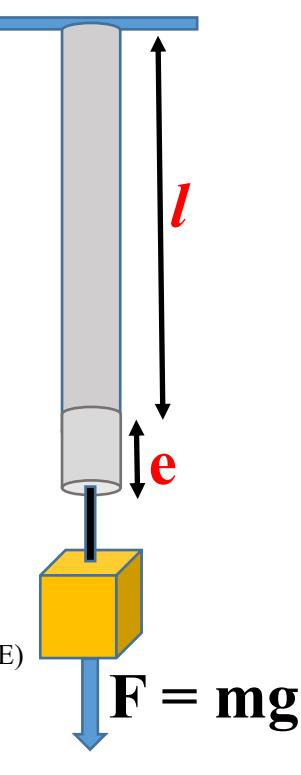
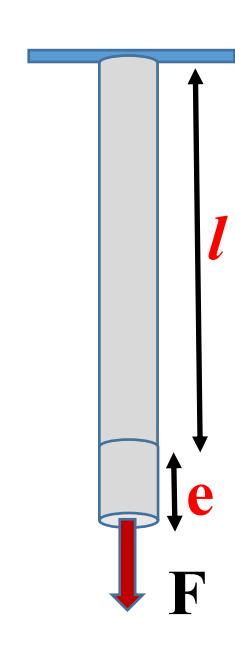
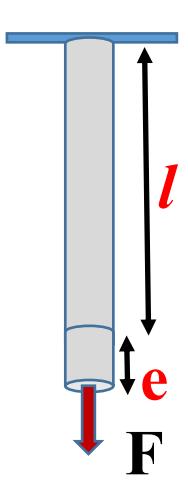
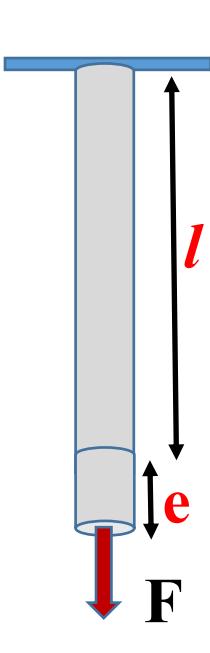
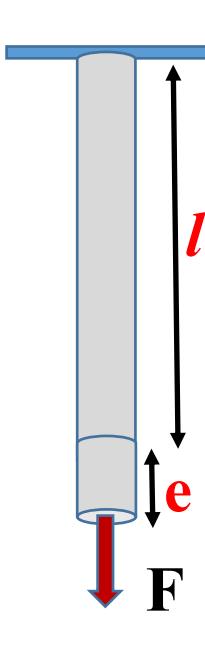
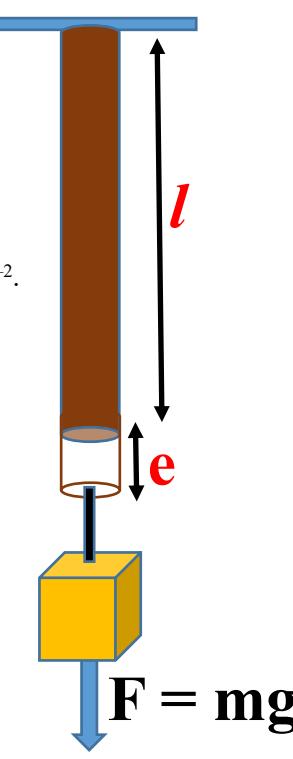
(vi) Young’s modulus of elasticity, Y=FleAY = \frac{Fl}{eA}

(vii) Elastic potential energy stored, E=12E = \frac{1}{2} .F.e

(ix) Energy density, ρE=12\rho_E = \frac{1}{2} stress × strain

(x) Bulk Modulus, K=NormalstressVolumetricstrainK = \frac{Normal stress}{Volumetric strain}

(xi) Modulus of rigidity (η)=Tangential stressShear strain(\eta) = \frac{\text{Tangential stress}}{\text{Shear strain}}

(xii) Poisson’s ratio ( σ\sigma ) = Lateral strainLongitudinal strain\frac{\text{Lateral strain}}{\text{Longitudinal strain}}

(xiii) Shearing strength = Forcearea\frac{\text{Force}}{\text{area}}

(xiv) Density, ρ=massvolume=mA.l\rho = \frac{\text{mass}}{\text{volume}} = \frac{\text{m}}{\text{A.}l}

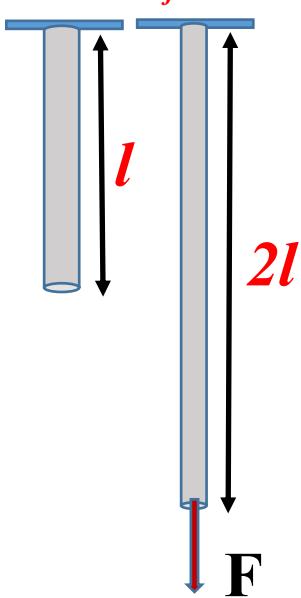
37. What force is required to stretch a steel wire of cross sectional area 1 cm2 to double its length?

Section titled “37. What force is required to stretch a steel wire of cross sectional area 1 cm2 to double its length?”

[YSteel=2×10¹¹ N/m][Y_{Steel} = 2 \times 10^{11} \text{ N/m}]

Solution:

Force, F = ?

Area of cross-section, A=1 cm2A = 1 \text{ cm}^2

A=(1×10²)2 m2=1×10⁴ m2A = (1 \times 10^{-2})^2 \text{ m}^2 = 1 \times 10^{-4} \text{ m}^2

Let initial length, l1=ll_1 = l

Then final length, l2=2ll_2 = 2l

Elongation, e=l2l1=2ll=le = l_2 - l_1 = 2l - l = l

\therefore Elongation, e = l

YSteel=2×10¹¹ N/m2Y_{Steel} = 2 \times 10^{11} \ N/m^2

We know,

Young’s modulus of elasticity,

Y=FleAY = \frac{Fl}{eA}

Or, F=YAelF = \frac{YAe}{l}

Or, F=2×10¹¹×l×1×10⁴lF = \frac{2 \times 10^{11} \times l \times 1 \times 10^{-4}}{l}

F=2×10⁷ N\therefore F = 2 \times 10^7 \text{ N}

  1. Calculate the work done in stretching a steel wire 100 cm in length and of cross sectional area 0.030 cm2 when a load of 100 N is slowly applied before the elastic limit is reached. [ YSteel=2×10¹¹ N/mY_{Steel} = 2 \times 10^{11} \text{ N/m} ]

Solution

Here,

Work done, W = ?

Length of wire, l = 100 cm = 1 m

Cross-sectional area, A=0.03 cm2A = 0.03 \text{ cm}^2

A=0.03×(1×102)2 m2A = 0.03 \times (1 \times 10^{-2})^2 \text{ m}^2

A=0.03×10⁴ m2A = 0.03 \times 10^{-4} \text{ m}^2

Force, F = 100 N

YSteel=2×10¹¹ Nm2Y_{Steel} = 2 \times 10^{11} \text{ Nm}^{-2}

We know,

Young’s modulus of elasticity

Y=FleAY = \frac{Fl}{eA}

Or, e=FlYAe = \frac{Fl}{YA}

Or, e=100×12×1011×0.03×104e = \frac{100 \times 1}{2 \times 10^{11} \times 0.03 \times 10^{-4}}

Elongation, e=16000e = \frac{1}{6000} m

Now,

Work done (W) = Energy stored (E)

Or, W=12W = \frac{1}{2} .F .e
Or, W=12×100×16000W = \frac{1}{2} \times 100 \times \frac{1}{6000}

  1. Find the work done in stretching a wire of cross sectional area 10210^{-2} cm2 and 2m long through 0.1 mm, If Y for the material of wire is 2×10112 \times 10^{11} Nm-2.

Solution

Here,

Work done, W = ?

W=8.33×10³JW = 8.33 \times 10^{-3} J

Cross-sectional area, A=102 cm2A = 10^{-2} \text{ cm}^2

A=102×(1×102)2 m2A = 10^{-2} \times (1 \times 10^{-2})^2 \text{ m}^2 A=1×10⁶ m2A = 1 \times 10^{-6} \text{ m}^2

Length of wire, l = 2 m

Elongation, e=0.1 mm=0.1×10³ me = 0.1 \text{ mm} = 0.1 \times 10^{-3} \text{ m}

YSteel=2×10¹¹ Nm2Y_{Steel} = 2 \times 10^{11} \text{ Nm}^{-2}

We know,

Young’s modulus of elasticity

Y=FleAY = \frac{Fl}{eA}

F=YeAlF = \frac{Y e A}{l}

F=2×1011×0.1×103×1×1062F = \frac{2 \times 10^{11} \times 0.1 \times 10^{-3} \times 1 \times 10^{-6}}{2}

F=10NF = 10 N

Now, work done, (W) = Energy stored (E)

W=12.F.eW = \frac{1}{2} .F.e

W=12×10×0.1×103W = \frac{1}{2} \times 10 \times 0.1 \times 10^{-3}

W=5×10⁴JW = 5 \times 10^{-4} J

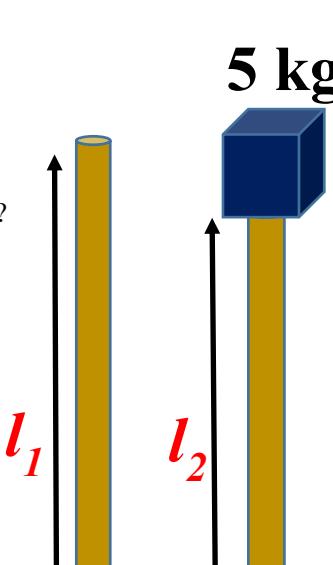
  1. A vertical brass rod of circular section is loaded by placing of 5 kg weight on top of it. If its length is 50 cm and radius of cross section is 1 cm, find the contraction of the rod and the energy stored in it.

[YBrass=3.5×10¹⁰ Nm2][Y_{Brass} = 3.5{\times}10^{10}~Nm^{-2}]

Solution

Here,

Mass on top, m = 5 kg

Length of rod, l = 50 cm = 0.5 m

Radius, r=1 cm=1×10² mr = 1 \text{ cm} = 1 \times 10^{-2} \text{ m}

  • (i) Contraction, e (or Δl\Delta l or lllll_l l_l ) = ?
  • (ii) Energy stored, E = ?

YBrass=3.5×10¹⁰ Nm2Y_{Brass} = 3.5 \times 10^{10} \text{ Nm}^{-2}

We know,

Young’s modulus of elasticity

Y=FleAY = \frac{Fl}{eA}

e=FlYAe = \frac{Fl}{YA}

e=mglY×πr2e = \frac{mg l}{Y \times \pi r^2}

e=5×10×0.53.5×1010×π(1×10²)2e = \frac{5 \times 10 \times 0.5}{3.5 \times 10^{10} \times \pi (1 \times 10^{-2})^2}

\therefore Contraction, e = 2.27×10⁻⁶ m Now,

Energy stored, E=12E = \frac{1}{2} .F .e

E=12×mg×eE = \frac{1}{2} \times mg \times e

E=12×5×10×2.27×106E = \frac{1}{2} \times 5 \times 10 \times 2.27 \times 10^{-6}

E=5.68×10⁵J\therefore E = 5.68 \times 10^{-5} J

42. Calculate the work done in stretching a steel wire 100 cm in length and of cross sectional area 0.03 cm2 when a load of 100 N is slowly applied without the elastic limit being reached. [ YSteel=2×10¹¹Y_{Steel} = 2 \times 10^{11} N/m]

Section titled “42. Calculate the work done in stretching a steel wire 100 cm in length and of cross sectional area 0.03 cm2 when a load of 100 N is slowly applied without the elastic limit being reached. [ YSteel=2×10¹¹Y_{Steel} = 2 \times 10^{11}YSteel​=2×10¹¹ N/m]”

Solution

Work done, W = ?

Length of wire, l = 100 cm = 1 m

Cross-sectional area, A=0.03 cm2A = 0.03 \text{ cm}^2

A=0.03×(1×102)2 m2A = 0.03 \times (1 \times 10^{-2})^2 \text{ m}^2

A=0.03×10⁴ m2A = 0.03 \times 10^{-4} \text{ m}^2

Force, F = 100 N

YSteel=2×10¹¹ Nm2Y_{Steel} = 2 \times 10^{11} \ Nm^{-2}

We know,

Young’s modulus of elasticity

Y=FleAY = \frac{Fl}{eA}

e=FlYAe = \frac{Fl}{YA}

e=100×12×1011×0.03×104e = \frac{100 \times 1}{2 \times 10^{11} \times 0.03 \times 10^{-4}}

Elongation, e=16000e = \frac{1}{6000} m

Now, work done (W) = Energy stored (E)

W=12.F.eW = \frac{1}{2} .F.e

W=12×100×16000W = \frac{1}{2} \times 100 \times \frac{1}{6000}

W=8.33×10³JW = 8.33 \times 10^{-3} J

Q. No. 36. A uniform steel wire of density 8000 Kgm-3 weight 20 g and is 2.5 m long. It lengthens by 1 mm when trenched by a force of 80 N. Calculate the value of the Young’s modulus of steel and the energy stored in the wire.

Section titled “Q. No. 36. A uniform steel wire of density 8000 Kgm-3 weight 20 g and is 2.5 m long. It lengthens by 1 mm when trenched by a force of 80 N. Calculate the value of the Young’s modulus of steel and the energy stored in the wire.”

Solution:

Here,

Density of steel wire, ρ=8000 kgm3\rho = 8000 \text{ kgm}^{-3}

Mass of wire, m=20g=20×103kgm = 20g = 20 \times 10^{-3} kg

Length of wire l = 2.5m

Elongation, e=1mm=1×10³me = 1mm = 1 \times 10^{-3}m

Force, F = 80 N

Young’s modulus of steel, Y = ?

Energy stored in the wire, E = ?

We have,

Young’s modulus of elasticity,

Y=FleA(i)Y = \frac{Fl}{eA} \dots (i)

Again,

Density, ρ=massvolume=mA.l\rho = \frac{\text{mass}}{\text{volume}} = \frac{\text{m}}{\text{A.}l}

A=mρl=20×1038000×2.5A = \frac{m}{\rho l} = \frac{20 \times 10^{-3}}{8000 \times 2.5}

A=1×10⁶ m2A = 1 \times 10^{-6} \text{ m}^2

From equation (i),

Y=FleA=80×2.51×103×1×106Y = \frac{Fl}{eA} = \frac{80 \times 2.5}{1 \times 10^{-3} \times 1 \times 10^{-6}}

Y=2×10¹¹ Nm2\therefore Y = 2 \times 10^{11} \text{ Nm}^{-2}

Now.

Energy stored in the stretched wire,

E=12E = \frac{1}{2} .F .e

Or, E=12×80×1×103E = \frac{1}{2} \times 80 \times 1 \times 10^{-3}

Or, E=40×103JE = 40 \times 10^{-3} J

  1. A uniform Steel wire of density 7800 Kgm-3 weights 16 gm and is 250 cm long. It lengthens by 1.2 mm when is stretched by a force of 80 N. Calculate the Young’s modulus and energy stored in the wire. Solution:

Here,

Density of steel wire, ρ=7800 kgm3\rho = 7800 \text{ kgm}^{-3}

Mass of wire, m=16g=16×103kgm = 16 g = 16 \times 10^{-3} kg

Length of wire l = 250 cm = 2.5 m

Elongation, e=1.2 mm=1.2×10³ me = 1.2 \text{ mm} = 1.2 \times 10^{-3} \text{ m}

Force, F = 80 N

Young’s modulus of steel, Y = ?

Energy stored in the wire, E = ?

We have,

Young’s modulus of elasticity,

Y=FleAY = \frac{Fl}{eA} …(i)

Again,

Density, ρ=massvolume=mA.l\rho = \frac{\text{mass}}{\text{volume}} = \frac{\text{m}}{\text{A.}l}

A=mρlA = \frac{m}{\rho l}

From equation (i),

Y=Fle×ρlmY = \frac{Fl}{e} \times \frac{\rho l}{m}

Or, Y=80×2.51.2×103×7800×2.516×103Y = \frac{80 \times 2.5}{1.2 \times 10^{-3}} \times \frac{7800 \times 2.5}{16 \times 10^{-3}}

Y=2.03×10¹¹ Nm2Y = 2.03 \times 10^{11} \text{ Nm}^{-2}

Now,

Energy stored in the stretched wire,

E=12E = \frac{1}{2} .F .e

Or, E=12×80×1.2×103E = \frac{1}{2} \times 80 \times 1.2 \times 10^{-3}

Or, E=4.8×10² JE = 4.8 \times 10^{-2} \text{ J}

46. A steel wire of density 8000 Kgm-3 weights 24 g and is 250 cm long. It lengthens by 1.2 mm when is stretched by a force of 80 N. Calculate the Young’s modulus of Steel and the energy stored in the wire. Solution:

Section titled “46. A steel wire of density 8000 Kgm-3 weights 24 g and is 250 cm long. It lengthens by 1.2 mm when is stretched by a force of 80 N. Calculate the Young’s modulus of Steel and the energy stored in the wire. Solution:”

Here,

Density of steel wire, ρ=8000 kgm3\rho = 8000 \text{ kgm}^{-3}

Mass of wire, m=24g=24×103kgm = 24 g = 24 \times 10^{-3} kg

Length of wire l = 250 cm = 2.5 m

Elongation, e=1.2 mm=1.2×10³me = 1.2 \text{ mm} = 1.2 \times 10^{-3} \text{m}

Force, F = 80 N

Young’s modulus of steel, Y = ?

Energy stored in the wire, E = ?

We have,

Young’s modulus of elasticity,

Y=FleAY = \frac{Fl}{eA} …(i)

Again,

Density, ρ=massvolume=mA.l\rho = \frac{\text{mass}}{\text{volume}} = \frac{\text{m}}{\text{A.}l}

A=mρlA = \frac{m}{\rho l}

From equation (i),

Y=Fle×ρlmY = \frac{Fl}{e} \times \frac{\rho l}{m}

Or, Y=80×2.51.2×103×8000×2.524×103Y = \frac{80 \times 2.5}{1.2 \times 10^{-3}} \times \frac{8000 \times 2.5}{24 \times 10^{-3}}

Y=1.389×10¹¹ Nm2Y = 1.389 \times 10^{11} \text{ Nm}^{-2}

Now,

Energy stored in the stretched wire,

E=12.F.eE = \frac{1}{2} .F.e

Or, E=12×80×1.2×103E = \frac{1}{2} \times 80 \times 1.2 \times 10^{-3}

Or, E=4.8×10² JE = 4.8 \times 10^{-2} \text{ J}

  1. A uniform steel wire of density 7800 Kgm-3 weights 16 gram and is 250 cm. It lengthens by 1.2 mm when a load of 8 kg is applied. Calculate the value of Young’s modulus for the steel and the energy stored in the wire.

Solution:

Here,

Density of steel wire, ρ=7800 kgm3\rho = 7800 \text{ kgm}^{-3}

Mass of wire, m=16g=16×103kgm = 16 g = 16 \times 10^{-3} kg

Length of wire l = 250 cm = 2.5 m

Elongation, e=1.2 mm=1.2×10³ me = 1.2 \text{ mm} = 1.2 \times 10^{-3} \text{ m}

Hanging mass, M = 8 Kg

Young’s modulus of steel, Y = ?

Energy stored in the wire, E = ?

We have,

Young’s modulus of elasticity,

Y=FleAY = \frac{Fl}{eA}

Y=Mg×leAY = \frac{Mg \times l}{eA} …(i) [F = Mg]

Again,

Density, ρ=massvolume=mA.l\rho = \frac{\text{mass}}{\text{volume}} = \frac{\text{m}}{\text{A.}l}

A=mρlA = \frac{m}{\rho l}

From equation (i),

Y=Fle×ρlmY = \frac{Fl}{e} \times \frac{\rho l}{m}

Or, Y=8×10×2.51.2×103×7800×2.516×103Y = \frac{8 \times 10 \times 2.5}{1.2 \times 10^{-3}} \times \frac{7800 \times 2.5}{16 \times 10^{-3}}

Y=2.03×10¹¹ Nm2Y = 2.03 \times 10^{11} \text{ Nm}^{-2}

Now.

Energy stored in the stretched wire,

E=12.F.eE = \frac{1}{2} .F.e

Or, E=12×80×1.2×103E = \frac{1}{2} \times 80 \times 1.2 \times 10^{-3}

Or, E=4.8×10²JE = 4.8 \times 10^{-2} J

  1. A wire of length 2.5 m and area of cross section 1×1061 \times 10^{-6} m2 has a mass of 15 kg hanging on it. What is the extension produced? How much is the energy stored in the standard wire if Young’s modulus of wire is 2×10112 \times 10^{11} Nm-2.

Solution:

Here,

Length of wire l = 2.5m

Area of cross-section, A=1×10⁶ m2A = 1 \times 10^{-6} \text{ m}^2

Hanging mass, m = 15 kg

Elongation, e = ?

Force, F = 80 N

Energy stored in the wire, E = ?

Young’s modulus of steel, Y=2×10¹¹ Nm2Y = 2 \times 10^{11} \text{ Nm}^{-2} .

We have,

Young’s modulus of elasticity,

Y=FleAY = \frac{Fl}{eA}

e=FlVAe = \frac{Fl}{VA} [here, F=mgF = mg ]

e=15×10×2.52×1011×1×106e = \frac{15 \times 10 \times 2.5}{2 \times 10^{11} \times 1 \times 10^{-6}}

e=1.875×10³ me = 1.875 \times 10^{-3} \text{ m}

Again,

Energy stored in the stretched wire,

E=12.F.eE = \frac{1}{2} .F.e

Or, E=12×mg×eE = \frac{1}{2} \times mg \times e

Or, E=12×15×10×1.875×103E = \frac{1}{2} \times 15 \times 10 \times 1.875 \times 10^{-3}

40. A steel cable with cross sectional area 3 cm23 \text{ cm}^2 has an elastic limit of 2.40×1082.40 \times 10^8 pa. Find the maximum of upward acceleration that can be given a 1200 kg elevator supported by the cable if the stress is not exceed one third of the elastic limit.

Section titled “40. A steel cable with cross sectional area 3 cm23 \text{ cm}^23 cm2 has an elastic limit of 2.40×1082.40 \times 10^82.40×10⁸ pa. Find the maximum of upward acceleration that can be given a 1200 kg elevator supported by the cable if the stress is not exceed one third of the elastic limit.”

Cross-sectional area, A=3 cm2=3×(1×102)2A = 3 \text{ cm}^2 = 3 \times (1 \times 10^{-2})^2

Or. A=3×10⁴ m2A = 3 \times 10^{-4} \text{ m}^2

Elastic limit = 2.4×1082.4 \times 10^8 pa (i.e. Nm-2)

Maximum upward acceleration, amax=?a_{max} = ?

Mass of elevator, m = 1200 kg

Maximum stress = 13\frac{1}{3} of elastic limit

Or, Force (maxm)area=13×elastic limit\frac{\text{Force (max}^{\text{m}})}{\text{area}} = \frac{1}{3} \times \text{elastic limit}

Or, m×amaxA=13×elasticlimit\frac{m \times a_{max}}{A} = \frac{1}{3} \times elastic limit

Or, amax=13×Am× elastic limita_{max} = \frac{1}{3} \times \frac{A}{m} \times \text{ elastic limit}

Or, amax=13×3×1041200×2.4×108a_{\text{max}} = \frac{1}{3} \times \frac{3 \times 10^{-4}}{1200} \times 2.4 \times 10^{8}

Or, amax=20 ms2a_{max} = 20 \text{ ms}^{-2}

43. How much force is required to punch a hole 1 cm in diameter in a steel sheet 5mm thick whose shearing strength is 2.76×10⁸ Nm22.76 \times 10^8 \ Nm^{-2} .

Section titled “43. How much force is required to punch a hole 1 cm in diameter in a steel sheet 5mm thick whose shearing strength is 2.76×10⁸ Nm−22.76 \times 10^8 \ Nm^{-2}2.76×10⁸ Nm−2 .”

Solution

Here,

Force, F = ?

Diameter of hole, d = 1 cm

\therefore Radius of hole, r=0.5r = 0.5 cm

r=0.5×10² mr = 0.5 \times 10^{-2} \text{ m}

Thickness of steel sheet, t = 5 mm

t=5×10³ mt = 5 \times 10^{-3} \text{ m}

Shearing strength = 2.76×10⁸Nm22.76 \times 10^8 \,\text{Nm}^{-2} We have,

Shearing strength = Forcearea\frac{\text{Force}}{\text{area}}

Or, F=Shearingstrength×C×tF = Shearing strength \times C \times t

Or, F=Shearingstrength×2πr×tF = Shearing strength \times 2\pi r \times t

Or, F=2.76×108×2π×0.5×102×5×103F = 2.76 \times 10^8 \times 2\pi \times 0.5 \times 10^{-2} \times 5 \times 10^{-3}

Or, F=43353.98 NF = 43353.98 \text{ N}

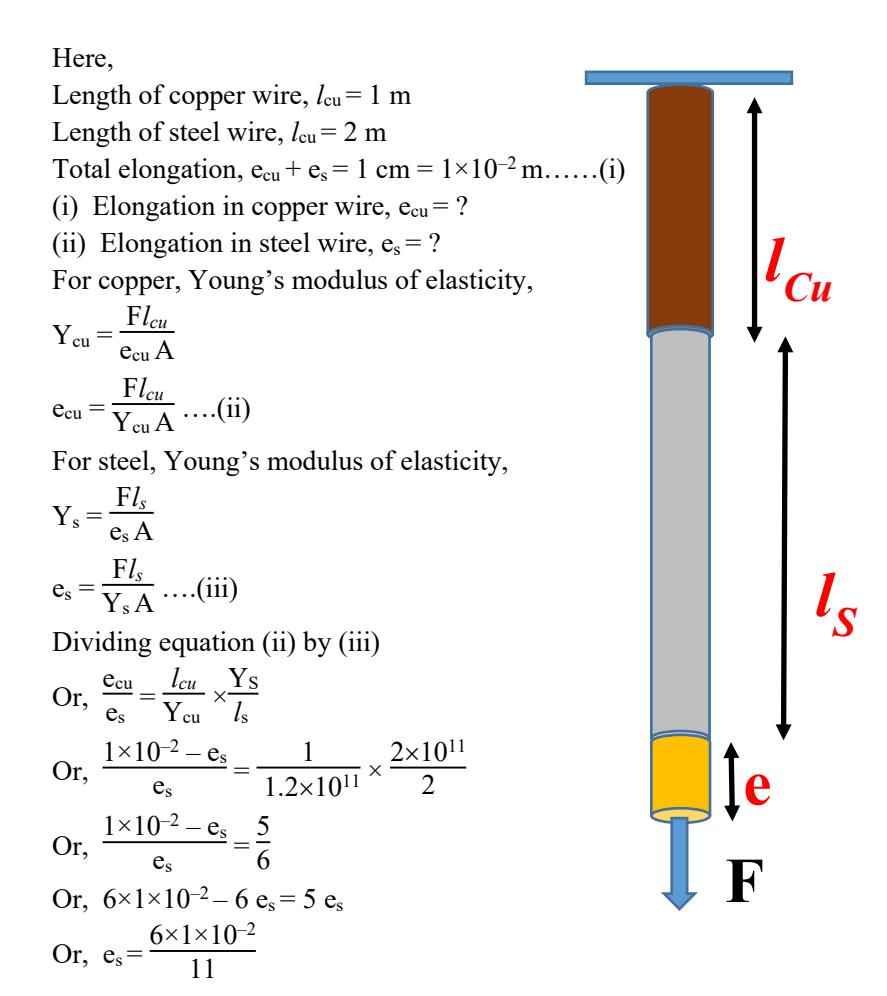
  1. A copper wire and a steel wire of the same cross sectional area and of length 1 m and 2 m respectively are connected end to end. A force is applied, which stretches their combined length by 1 cm. Find how much each wire is elongated. [ Ycopper=1.2×10¹¹ N/m2Y_{copper} = 1.2 \times 10^{11} \text{ N/m}^2 and [ Ysteel=2×10¹¹ N/m2Y_{steel} = 2 \times 10^{11} \text{ N/m}^2 ]

\therefore Elongation in steel wire, es=5.45×10³m.e_s=5.45\times 10^{-3}\,m. and elongation in copper wire, ecu=1×1025.45×103=4.54×10³me_{cu}=1\times 10^{-2}-5.45\times 10^{-3}=4.54\times 10^{-3}\,m

Q. No. 34. A rubber cord of a catapult has a cross-sectional area 1.0 mm2 and total un-stretched length 10 cm. It is stretched to 12 cm and then released to project a missile of mass 5.0 g. Calculate the velocity of projection. [ Yrubber=5×10⁸ N/m2Y_{rubber} = 5 \times 10^8 \text{ N/m}^2 ]

Section titled “Q. No. 34. A rubber cord of a catapult has a cross-sectional area 1.0 mm2 and total un-stretched length 10 cm. It is stretched to 12 cm and then released to project a missile of mass 5.0 g. Calculate the velocity of projection. [ Yrubber=5×10⁸ N/m2Y_{rubber} = 5 \times 10^8 \text{ N/m}^2Yrubber​=5×108 N/m2 ]”

Solution:

Area of cross-section, A=1 mm2A = 1 \text{ mm}^2

A=(1×10³)2 m2=1×10⁶ m2A = (1 \times 10^{-3})^2 \text{ m}^2 = 1 \times 10^{-6} \text{ m}^2

Un-stretched (original) length, l1=10 cm=10×102 ml_1 = 10 \text{ cm} = 10 \times 10^{-2} \text{ m}

Stretched (final) length, l2=12 cm=12×102 ml_2 = 12 \text{ cm} = 12 \times 10^{-2} \text{ m}

Elongation, e=l2l1e = l_2 - l_1

e=2cme = 2cm

e=2×10² me = 2 \times 10^{-2} \text{ m}

Mass of missile, m = 5g

m=5×10³ kgm = 5 \times 10^{-3} \text{ kg}

Velocity projection, v = ?

Yrubber=5×10⁸ N/m2Y_{rubber} = 5 \times 10^8 \text{ N/m}^2

We have,

Young’s modulus of elasticity,

Y=FleAY = \frac{Fl}{eA}

F=YAelF = \frac{YAe}{l}

F=5×108×2×10-2×1×10-610×10-2F = \frac{5{\times}10^8 \times 2{\times}10^{\text{-2}} \times 1{\times}10^{\text{-6}}}{10{\times}10^{\text{-2}}}

F=100 NF = 100 \text{ N}

Then,

Elastic energy stored in a stretched rubber

E=12.F.eE = \frac{1}{2} .F.e

E=12×100×2×102E = \frac{1}{2} \times 100 \times 2 \times 10^{-2}

E=1JE = 1 J

According to work energy theorem,

Elastic potential energy, E = K.E

Or, K.E=12.m.v2K.E = \frac{1}{2} .m . v^2

Or, 1=12×5×103 v21 = \frac{1}{2} \times 5 \times 10^{-3} \text{ v}^2

Or, v=25×103v = \sqrt{\frac{2}{5 \times 10^{-3}}}

Or, v=20 m/sv = 20 \text{ m/s}