
Elasticity Notes
Deforming force
Section titled “Deforming force”A force is said to be deforming force if it can change shape, size and position of the object.
Restoring force
Section titled “Restoring force”A force is said to be restoring fore if it brings the object back to its original shape, size and position after the removal of deforming force.
Elasticity
Section titled “Elasticity”Elasticity is the property of the body by virtue of which a deformed body regains its original shape, size and position after the removal of deforming force.
- The elasticity of the object generally decreases with increase in temperature.
- The elasticity of molten cadmium (Z = 48) and molten cupper increases with increase in temperature.
- The elasticity of invar is unaffected with the change in temperature.
Types of object on the basis of elasticity
Section titled “Types of object on the basis of elasticity”1. Elastic object:
Section titled “1. Elastic object:”An object is said to be elastic if it regains its original shape, size and position after the removal of deforming force.
For example; quartz, rubber, steel, iron etc.
2. Plastic object:
Section titled “2. Plastic object:”An object is said to be plastic if it doesn’t regain its shape, size and collision after the removal of deforming force.
For example: polythene, wax, etc.
3. Rigid object:
Section titled “3. Rigid object:”An object is said to be rigid if it doesn’t get reformed by an external force
For example: bricks, stones, etc.
Stress:
Section titled “Stress:”Stress is defined as the deforming force per unit area.
Mathematically,
It’s unit is N/m2.
Types of stress
Section titled “Types of stress”1. Normal stress:
Section titled “1. Normal stress:”A stress is said to be normal stress if deforming force is perpendicular to the area of cross section. Normal stress changes shape and size of the object.
Types of normal stress:
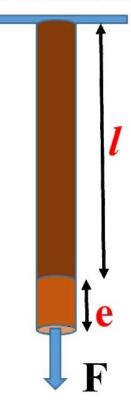
Section titled “Types of normal stress:”a. Tensile stress: Tensile stress is a type normal stress which can increase the length of the object.
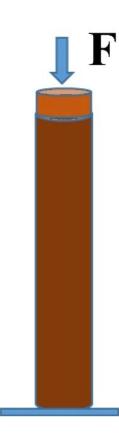
b. Compression stress: Compression stress is a type normal stress which can decrease the length of the object.
2. Tangential stress:
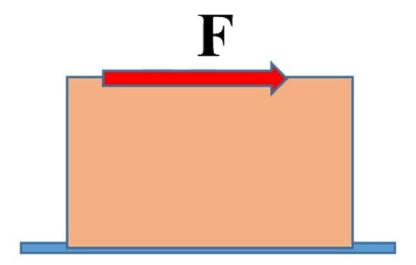
Section titled “2. Tangential stress:”A stress is said to be tangential if the deforming force is acting in the direction of area of cross-section (tangentially). It cannot change shape and size but changes the position of the object.
Strain:
Section titled “Strain:”Strain is defined as the change in configuration per unit original configuration. (Configuration means length, volume, angle, etc.). Mathematically,
Since it is the ratio of same physical quantity so it has no unit.
Types of strain
Section titled “Types of strain”(i) Longitudinal strain:
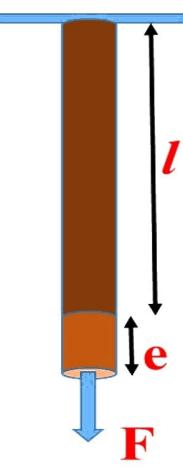
Section titled “(i) Longitudinal strain:”Longitudinal stress is defined as the change in length per unit original length. Mathematically,
Longitudinal strain =
Longitudinal strain =
Where ‘e’ stands for elongation
2. Volumetric strain:
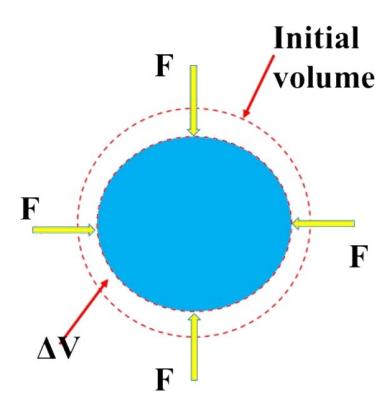
Section titled “2. Volumetric strain:”Volumetric strain is defined as the change in volume per unit original volume.
3. Shear strain:
Section titled “3. Shear strain:”Shear strain is defined as the angle through which an object is sheared with the application of tangential stress.
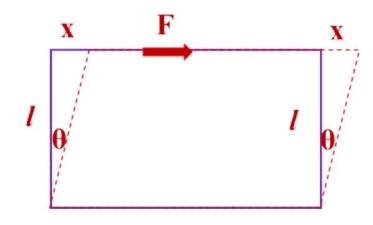
From figure,
For very small angle , is nearly equal to
Therefore, shear strain
Stress-strain curve:
Section titled “Stress-strain curve:”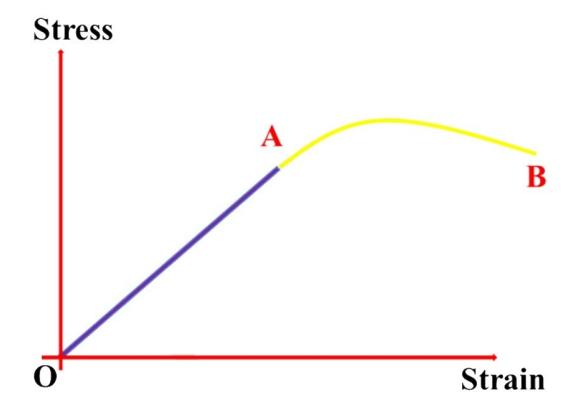
Let us consider a uniform wire is suspended at it’s one end on other end is attached to a scale pan. The weights on the pan are gradually increased and corresponding elongations are noted. A graph of stress and strain is plotted as shown in the figure above. Here OA is a straight line and AB is a curve, ‘A’ is called proportional limit, within the proportional limit stress is directly proportional to strain and B is called elastic limit, within the elastic limit the object retains elastic property. Beyond the elastic limit (point B), the object losses its elasticity i.e. the object cannot regain its original shape, size and position after the removal of deforming force.
Hooke’s law:
Section titled “Hooke’s law:”Hooke’s law states that within the proportional limit, stress is directly proportional to strain. i.e.
Stress
Or, Stress = E strain (where ‘E’ is proportionality constant and known as modulus of elasticity.)
It’s unit is Nm-2.
Experimental verification of Hooke’s Law:
Section titled “Experimental verification of Hooke’s Law:”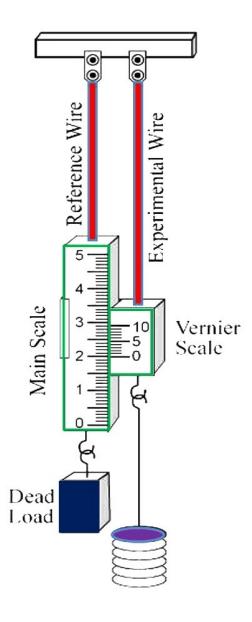
Fig: Verification of Hooke’s law
The experimental setup for the verification of Hooke’s law is shown above. It consists of a experimental wire, vernier-scale, a hanger with slotted weights. The weights on the hanger are gradually increases and corresponding elongations of wire are noted.
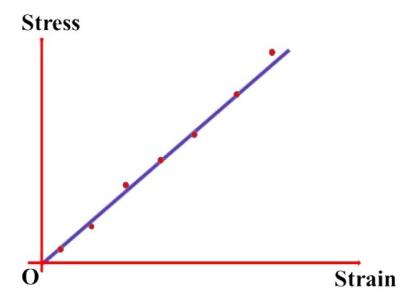
When a graph of different stress versus corresponding strain is plotted, a straight line passing through origin is obtained. This shows that stress is directly proportional to the strain which verifies Hooke’s law.
Types of modulus of elasticity
Section titled “Types of modulus of elasticity”(i) Young’s modulus of electricity (Y):
Section titled “(i) Young’s modulus of electricity (Y):”Young’s modulus of electricity is defined as the ratio of normal stress to the longitudinal strain. It is denoted by ‘Y’ i.e.
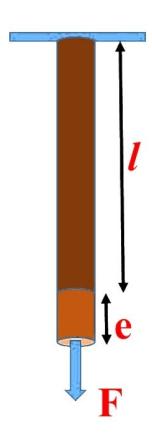
It’s unit is Nm-2.
Since Young’s modulus of elasticity ‘Y’ is the property of material and is independent of external dimensions of the wire.
Note:
Young’s modulus of elasticity is given by
For same F, l and A, we have
i.e., Young’s modulus is inversely proportional to elongation.
For example; rubber is less elastic than Steel because elongation produced in the rubber is more than that in steel. So, Young’s modulus of rubber is less. Hence rubber is less elastic. Similarly, elongation produced in the steel is more than that in rubber. So, Young’s modulus of steel is more. Hence steel is more elastic than rubber.
Determination of young’s modulus of elasticity ‘Y’
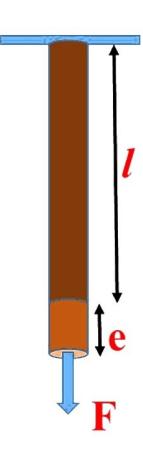
Let’s us consider a wire of length ‘l’ and cross-sectional area ‘A’ is suspended from a rigid support. A force is applied to the free end of the wire to produce an elongation ‘e’ as shown in figure above. Let ‘Y’ be the Young’s modulus of elasticity of the given wire then,
Normal stress =
and longitudinal strain =
Young’s modulus of elasticity ‘Y’ =
Or,
Measuring the values of Force (F), original length (l), elongation (e) and area of cross-section (A), Young’s modulus of elasticity is determined.
(ii) Bulk modulus of elasticity (K) or (B):
Section titled “(ii) Bulk modulus of elasticity (K) or (B):”It is defined as the ratio of normal stress to the volumetric strain i.e.,
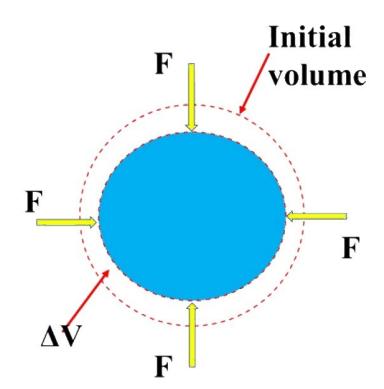
Let us consider a spherical object of volume V is compressed by the forces and its volume is decreased by .
Now,
Bulk modulus of elasticity (K) =
Or,
Or,
Note: Compressibility (C) is the reciprocal of bulk modulus of elasticity i.e.,
(iii) Modulus of rigidity ( ):
Section titled “(iii) Modulus of rigidity ( η\etaη ):”Modulus of rigidity is defined as the ratio of tangential stress to shear strain i.e.
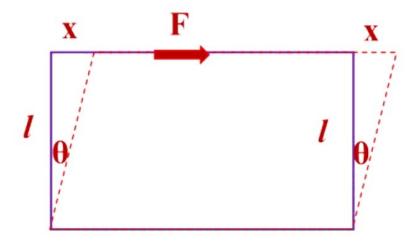
From figure tangential stress =
And, shear strain
Now.
Modulus of rigidity
Energy stored in a stretched wire:
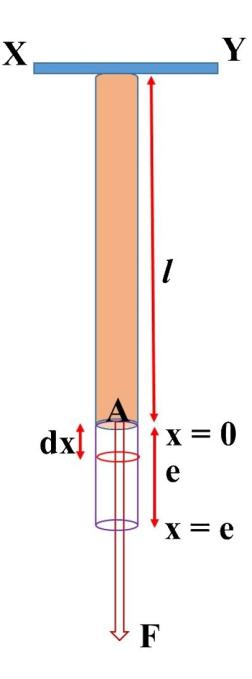
Let us consider on a uniform wire of length ‘l’ and area of cross section ‘A’ is fixed to a rigid support XY. A force ‘F’ is applied to the lower end of the wire to produce elongation from x = 0 to x = e as shown in figure above. Let ‘Y’ be the Young’s modulus of the wire then from the definition,
Young’s modulus
Let dx be the small elongation at any instant of time then small amount of work done in stretching the wire through ‘dx’ distance is
Using equation (i)
Now, the total amount of work done in stretching the wire through the distance (e) can be obtained by integrating equation (ii) from x = 0 to x = e, we get,
Or,
Or,
Or,
Or,
Or,
Or,
Or,
This amount of work done is stored as elastic potential energy in the wire. So the energy stored in stretched wire is
Energy Density:
Section titled “Energy Density:”Energy density is defined as energy stored in a stretched wire per unit volume. We know,
∴ Energy density, stress × strain
Poisson’s ratio (σ):
Section titled “Poisson’s ratio (σ):”Poisson’s ratio is defined as the ratio of lateral strain to longitudinal strain. It is denoted by and mathematically given by Poisson’s ratio
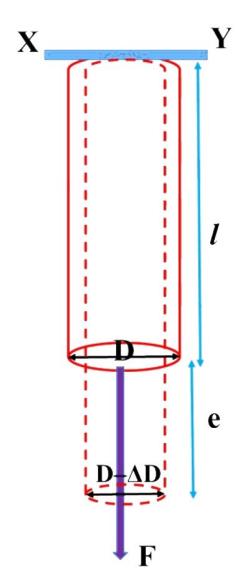
Let us consider a uniform wire of length ‘l’ and diameter ‘D’ is fixed to a rigid support XY. A force is applied to the lower end of the wire, so that it’s length is increased by ‘e’ and diameter is decreased by ’ D’ as shown in figure above.
From Figure,
And, longitudinal strain =
Now.
Poisson’s ratio ( ) =
The theoretical value of Poisson ratio lies between -1 to but it’s practical values lies between 0 to .
The Poisson’s ratio has maximum value for rubber since there is no change in volume of rubber when it is elongated or compressed.
Elastic After Effect:
Section titled “Elastic After Effect:”The delaying in the time to regain its original shape and size after the removal of deforming force is known as elastic after effect. The glass has maximum value of elastic after effect.
Elastic Fatigue:
Section titled “Elastic Fatigue:”With the application of alternate cycle of stress and strain, an elastic object losses its elastic property which is known as elastic fatigue. Due to elastic fatigue bridges are declared unsafe after long use.